
Pennsylvania Shakespeare Festival’s production of August Wilson’s “The Piano Lesson” packs quite a punch as the festival kicks off its 2026 season on the campus of DeSales University.
“The Piano Lesson” runs through June 14 in the Schubert Theatre, Labuda Center for the Performing Arts, DeSales University, 2755 Station Avenue, Center Valley.
With vivid performances by the cast and compelling storytelling, “The Piano Lesson” is a satisfyingly slow burn tale of family drama about legacy and trauma.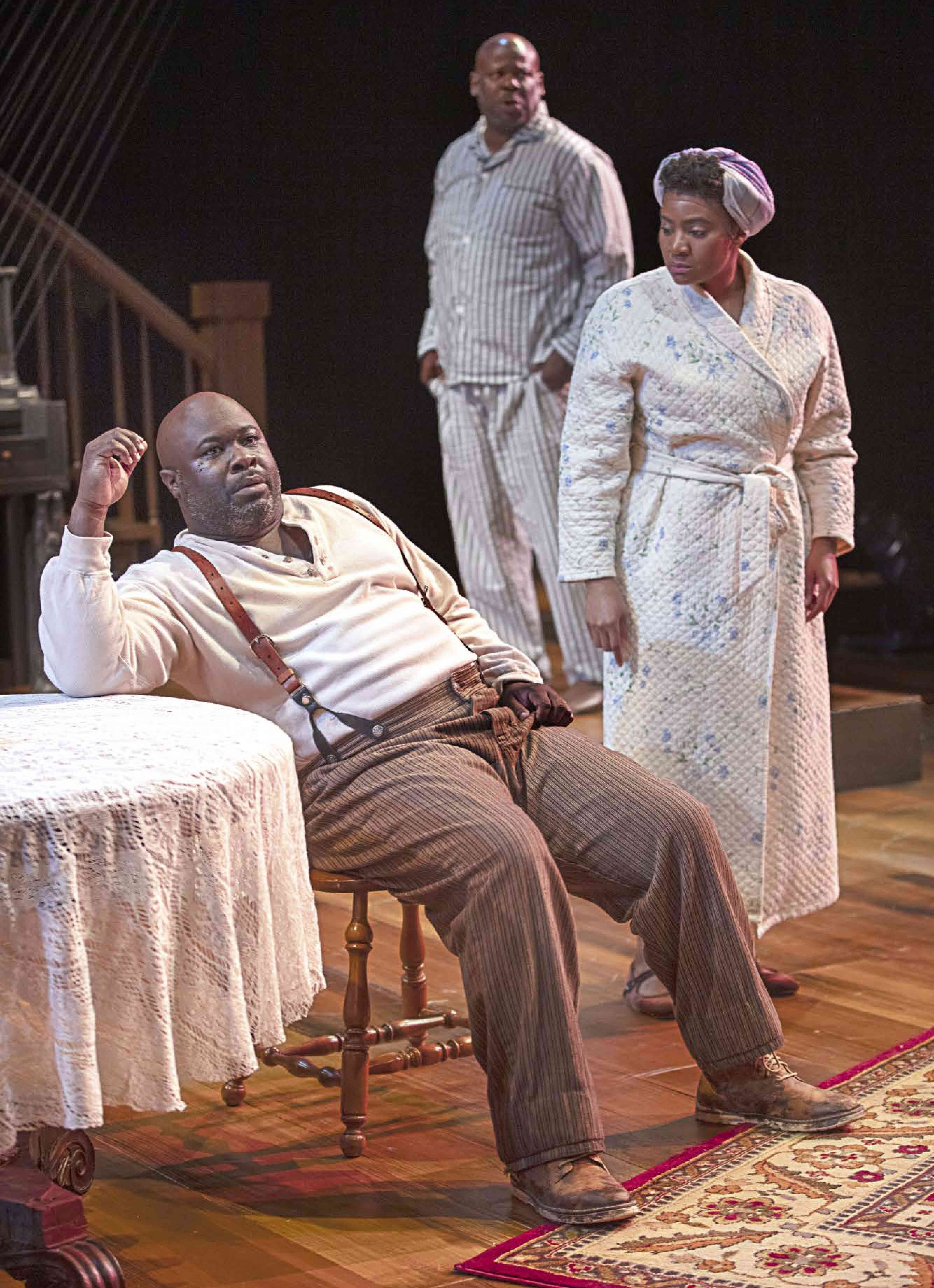
The production’s emotional power, rich performances, and musicality made the evening deeply absorbing.
Director James Ijames captures the music inherent in Wilson's powerful language that flows through the characters as they struggle to move forward.
The story concerns the battle between Berniece, a young widow who lives in her Uncle Doaker’s house with her preteen daughter Maretha (a delightful Leonice Diaz), and her brother Boy Willie who wants to sell the valuable piano, which Berniece adamently opposes.
Boy Willie arrives in Pittsburgh with his friend Lymon and a truckload of watermelons to sell. The money from that cargo will give him a stake to put toward a plot of Mississippi farmland whose owner, Sutter, fell down a well and died. Boy Willie figures that the sale of the piano will give him the final stake to buy that parcel of land, where his ancestors once worked as slaves.
Berniece is as skeptical of Boy Willie’s innocence in Sutter’s death as she is about his and Lymon’s legitimate ownership of the truck. Her suspicions are further inflamed by the appearance in the house of Sutter’s ghost, who seems to have followed Boy Willie all the way from Mississippi.
Jessica Johnson is wonderful as the word-weary Berniece, who works too much and is just trying to hold it all together. Johnson gives the character an iron will as well as a real-world sensitivity that comes out in scenes of domesticity when she’s preparing a meal or combing out Maretha’s hair. She also has a tender moment in her unsuspecting encounter with the lonely Lymon.
Her powerful performance in the play’s climax is unforgettable.
Akeem Davis is a driving force as Boy Willie, who forges ahead like a freight train. Davis’ kinetic portrayal energizes the stage every moment he is on it, whether plotting to sell watermelons, trying to steamroll over his stubborn sister or seduce a local woman (a playful Jessica Money).
Kash Goins vibrantly inhabits Doaker, who is infused with weary experience and wry wisdom, as he tries to run gentle interference between the warring siblings.
Christopher James Murray has a memorable turn as Lymon, Boy Willie’s guileless buddy who blindly follows Boy Willie’s lead. Murray brings a gentle humor to role of the rough-around-the-edges family friend and you can feel his touching yearning for a better future. Two of the play’s most delightful moments revolve around Lymon, when he eagerly buys an ill-fitting suit off the scamming Wining Boy and his heartbreaking moment with Berniece.
Terrence Clowe also is engaging as he mines the humor in his portrayal of Doaker’s shameless older brother Wining Boy.
Johnnie Hobbs III is appealing as the stalwart and earnest Avery, a pastor who wants to marry Berniece but is kept at hands length by her. Hobbs has Avery find his voice and his ambivalence fall away in the compelling climax.
In the climax, Ijames emphasizes the spiritual over the supernatural, making Boy Willie’s final decision feel more symbolic than visceral.
The play is 3 ½ hours long with one intermission. To Ijames’ credit, the story unfolds at the the perfect pace and the time flies by.
Meet the actors for an informal talk-back after the June 4 and 11 shows.
There will be an audio described performance for the blind or visually-impaired May 30.
“Epilogues” a free discussion and a behind-the-scenes look at the show at 10 a.m. June 13 will allow audience members to gain deeper insight and ask questions.
“The Piano Lesson” is recommended for ages 13 and up as the production contains references to slavery, racial violence, and family trauma, as well as supernatural elements and period-appropriate language including racial slurs.
Performances are 6:30 p.m. June 2 and 9; 2 p.m., and 7:30 p.m. June 3 and 13; 7:30 p.m. June 4, 5, 6, 10, 11 and 12 and 2 p.m. June 14.
For information, call 610-282-9455, or go to pashakespeare.org/.