
Belfast 1922.
Armed men bang on a door after dark as potential touts (spies) already sit at the supper table of an ordinary Catholic family trying live their lives.
Pending danger grips the evening.
Sharp questioning of guests by a wary matriarch.” From County Cork are you? And what town would that be?”
Rough intruders grill the guests—are they Republicans? Unionists? Catholics? Prods (Protestants)?
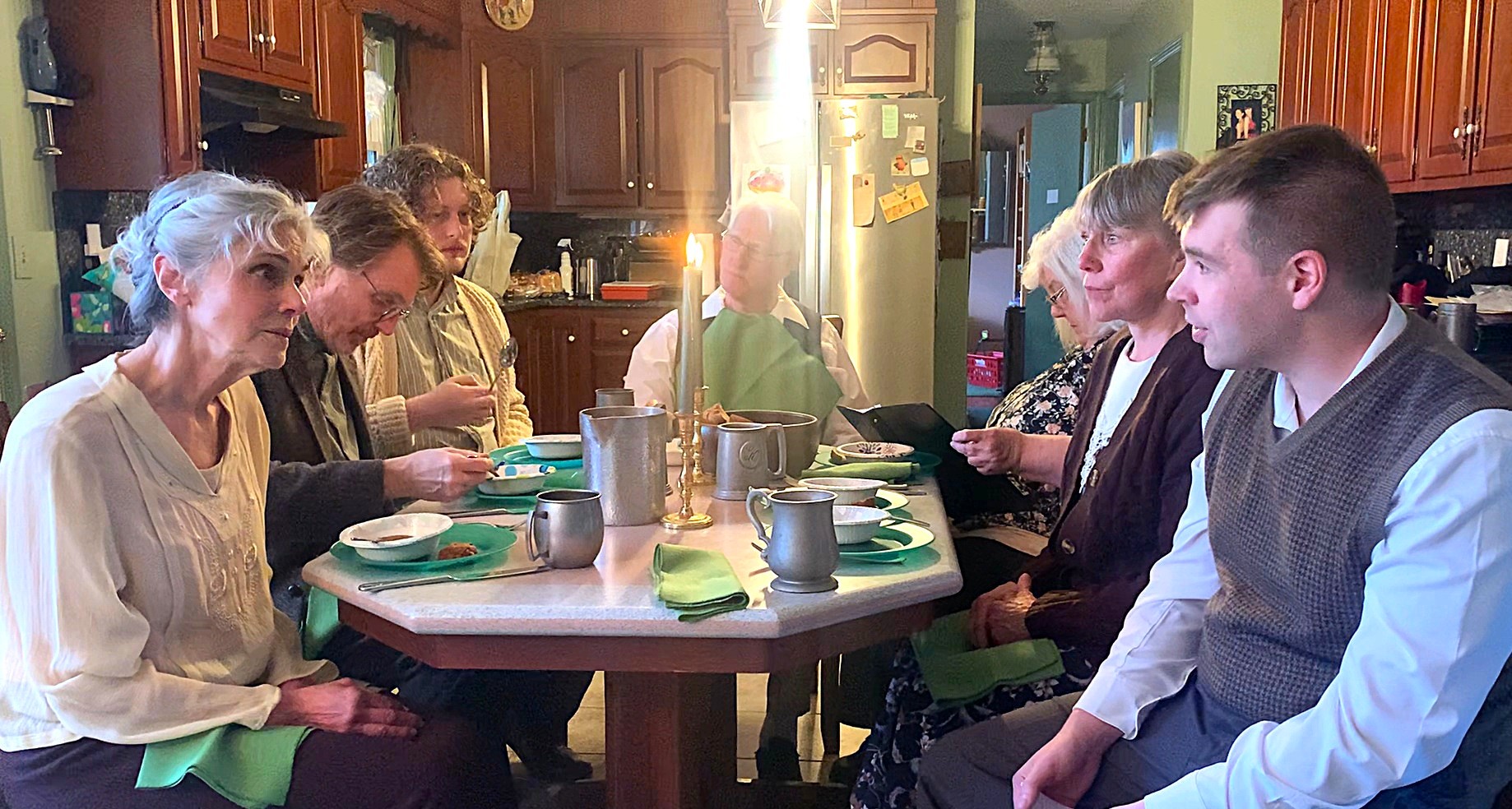
“A Terrible Beauty,” a play by Lehigh Valley playwright Ara Barlieb that depicts a small slice of the bloody Irish “Troubles” will run March 12, 13, 14 at 7:30 p.m. and March 15 at 2 p.m. at the Charles A. Brown Icehouse at 56 River St., Bethlehem.
An early look of the work promises a spellbinding drama as trusted friends and acquaintances, gathered for a traditional Irish meal, face treachery.
According to the playwright, Ara Barlieb,
“Every word of it is ‘true’”, said the prolific writer in a recent interview, “in the sense that the expressions used, the foods being prepared, the dinner table rituals being talked about but largely ignored, the stories of Irish history and wars, all of it is documented and loosely adapted from actual events--- an attack on the McMahon family by the Royal Ulster Constabulary in March 1922.”
Through the tight dialog by the veteran troupe, Crowded Kitchen Players, the audience will be educated about events that are vaguely remembered histories to most theater goers.
Several historical events are referenced in “A Terrible Beauty.” Since the protagonists in this story are firmly rooted in the history of Ireland, these details provide the riveting backstory.
1690? The Battle of Boyne when King William III of Orange' Protestant army defeated the Catholic forces under King James II assuring Protestant ascendency in Ireland.
It continued a twisted thread in the tapestry of Irish history. That thread is now central in the warp and weave of “The Troubles”. It is never far removed from the generational memory of Irish wherever they live.
1844? The Great Potato Famine. The Irish starved and still hold the British responsible.
1916? The Easter Rising. The Irish rebel against British rule in Ireland.
1923? End of the Civil War was followed by executions whose bitter legacy lives on today.
The play begins in 1922. All the men in a family were executed in the real history, but what happens in the play?
Why does this story resonate today?
Barlieb, who has a reputation for facing contemporary issues head on, writes about the same tribal forces that are at play today both at home and around the world.
What is your party? Where are you from? What religion are you?
Civil wars around the world and through time have ugly themes no matter what cause is aspiring to power: brother against brother; families destroyed; martyrs immolating themselves or blowing innocent people to smithereens with explosive vests; neighbors snitching on neighbors resulting in disappearances, beatings, or prison terms for free speech--protesting, agitating.
Mayors and village chiefs assassinated; Innocents who simply want to live, forfeit their lives because terror is a tactic.
Whole classes of society chopped in the neck with shovels because they are teachers, officers, journalists, scientists, or just because they wear glasses and thus are deemed a threat.
Barlieb and the Crowded Kitchen Players previously explored this theme in a gut-wrenching trilogy exploring the brutal Irish Civil War.
Maybe it’s human nature, but “A Terrible Beauty” brings it home when goodness and evil sit at the same supper table.
TICKETS: All tickets $15
Credit card purchase at ckplayers.com
Cash or check only at the door
INFORMATION: 610-704-6974, www.ckplayers.com